Showing posts with label patterns. Show all posts

Friday, June 27, 2014

Latin Squares and Euler Squares

Yesterday in 4G, as a five minute thing at the start of the maths lesson, the challenge was to make Latin squares, where each colour appears only once in each row and column of a square:

Mr Gregg tweeted an image of this and got a reply that took it further:
So... diagonals...
We used a Word document (switching the gridlines - 2cm - on, to snap to grid) as there aren't enough plastic squares for everyone to have a go!
Ryan was the first one to get it!
Well done Ryan! After that, lots of others found a way.

Mr Gregg had had another tweet:

So, now for something much harder.... Euler squares! (We've met Mr Euler before!)

Mr Gregg had made a Word document for this too. This time there are shapes and colours, and both have to be organised!
Mr Gregg said we wouldn't try for very long because it looked very hard! But, just as he said, "Right, that's enough," Rozenn shouted out, "I've done it!"

And she had - well done Rozenn!
 Here it is, recreated in plastic squares:
A big thank you to all the people on twitter who helped us!

PS
Mr Euler said it was not possible to make this kind of square if its size is 2, 6, 10, 14...
He was right about 2 and 6, but in 1960 it was discovered it is possible with 10 and all the others:

Sunday, June 15, 2014

Our feelings about the Square from Cubes


After the creation of this huge Cuisenaire rod square, there were lots of things to say. Mr Gregg said a little about triangle numbers:


Then the creators of the square made a video about everyone's reaction to it:


Now, there's a display up outside the classroom:
So, we'll need to do some explaining of the maths behind it for the younger children that go past, how we got these:
 and then how we made this:
And some of the things we notice about the square.

Wednesday, June 11, 2014

Cubes to squares... BIG

In our exploration of number patterns with Cuisenaire rods (see the previous post) Clara and Rozenn began to explore the cubes to squares puzzle we'd looked at together yesterday:
Using cubes of each rod in turn
 they built up the square from the centre.
Claudia was busy making cubes - so she joined in!
At this point Mr Gregg thought it would be wise to stop - it would be difficult to find 49 sevens. But the girls were determined to press on - and they did it:
"Probably best to stop now," Mr Gregg said. "You'll never find 64 eights."
But - and Alicia joined the team now - the girls were not going to stop.
 Nines involved going to all the teachers in the school, and working through playtime.
"Hooray!"

The nines complete
 For the tens, we couldn't find a hundred of them, so the girls used some of the base 10 equipment:
 And - drum roll! - here it is!
There's a strange pattern of the odd and even numbers - can you see it?
And the lengths of the squares follows a neat pattern too!
On Friday we'll have another look at the numbers involved.
This pattern is amazing and beautiful - well done to the four girls for pushing on with it!

UPDATE
Alicia has some Cuisenaire rods at home - and this morning she brought in ten tens. Now almost all the tens are orange like they should be!

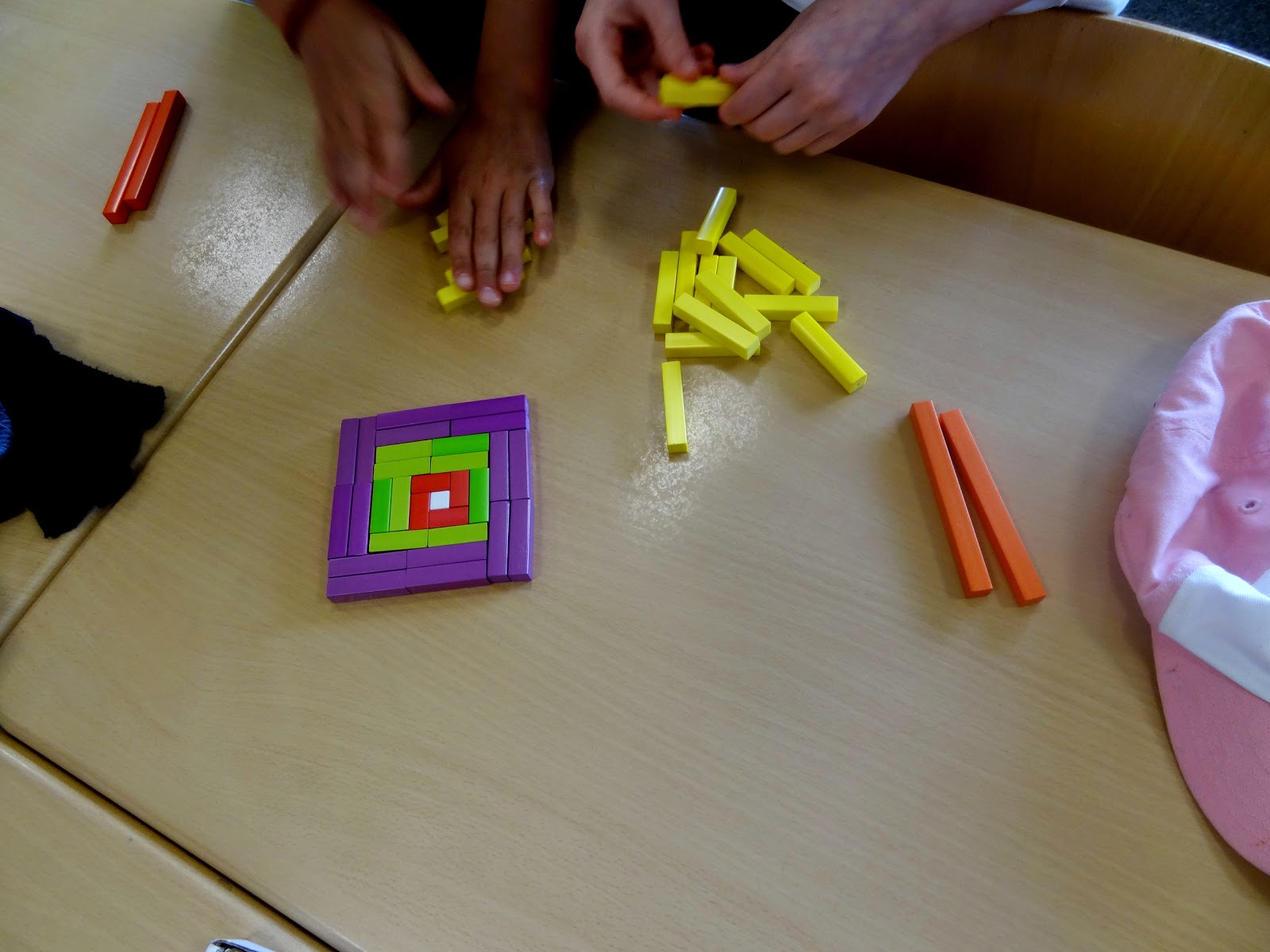
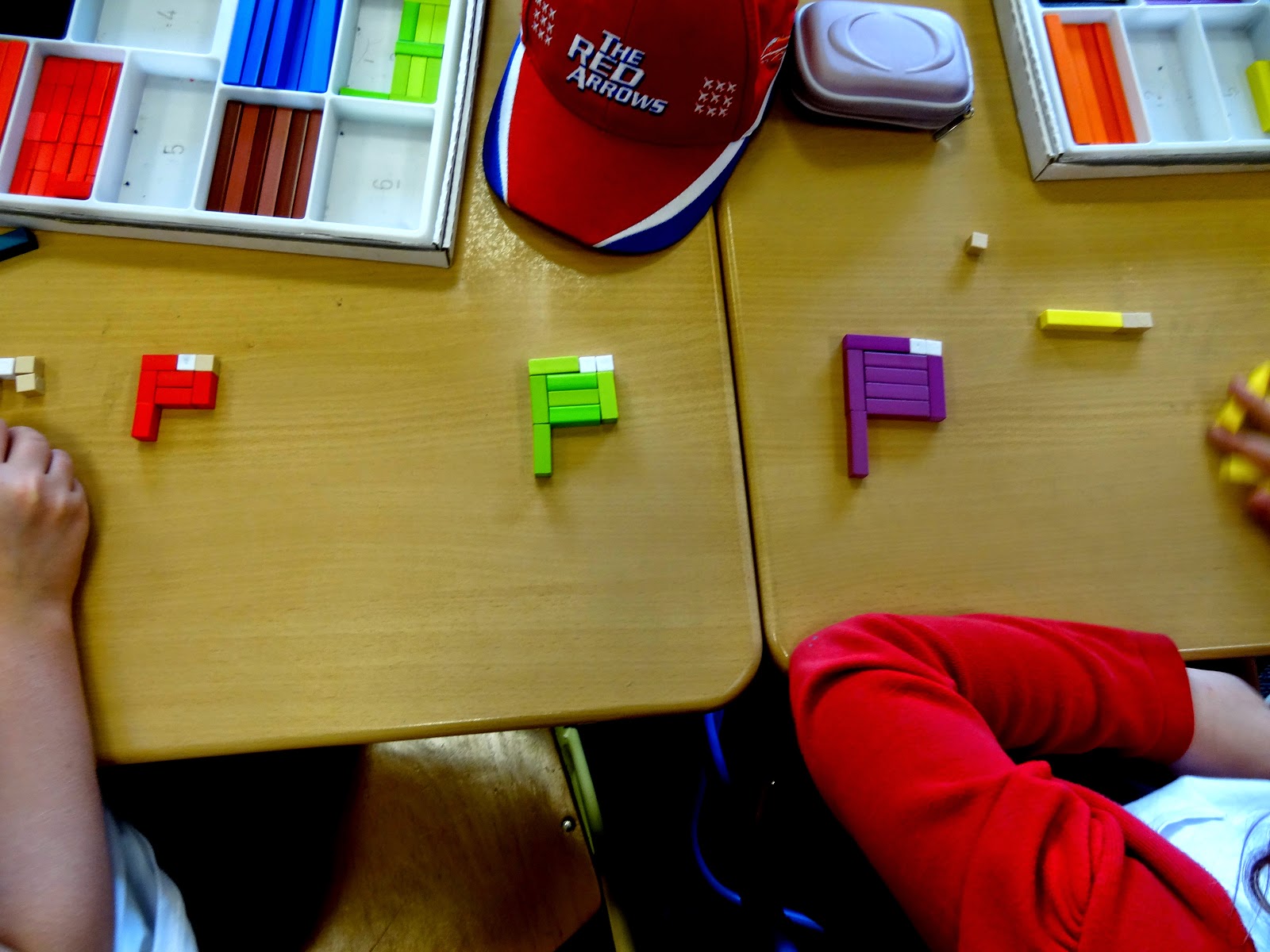
Patterns in Cuisenaire rods

Back in January we investigated patterns in match sticks. We returned to this kind of maths today, with a look at similar patterns in Cuisenaire rods.
These and more photos are in this slideshow:


We've begun to look at the numbers involved in each step, and the number pattern that goes with the rod pattern. Some were fairly simple; others will take more time.

One group with a this pattern though deserves a blog post of its very own. Here it is beginning to grow:

Tuesday, January 28, 2014

Match patterns - Number patterns

In Year 4 we've been exploring number patterns using headless matches. First of all we made step 1, step 2 and step 3 of a pattern:

5       10       15


3     6     9


Keeping on going we got to step numbers further on too:


The idea was to work out how the pattern was growing and then, without making it, to say how many matches would be in the 20th step. Quite tricky with some of the patterns!