Tuesday, June 10, 2014

Cubes to squares puzzle

Here's a little puzzle we tried in 4G. We made three cubes with Cuisenaire rods: a 1 x 1 x 1 cube, a 2 x 2 x 2 cube and a 3 x 3 x 3 cube.
Then, once we'd made them, we made a square with all the Cuisenaire rods that we'd used to make the cubes.


Here are some pictures:
the cubes

Then we made a 4 x 4 x 4 cube. After that, we added the fours we'd used into the square:

Then, some of us tried with five:
 Here's all the pictures:

Sunday, June 8, 2014

Bracelet and origami!

       All middle playtimes we are doing  bracelets and origami!
If you want to learn or do some you can join us in the play ground out side the library.
If you do some bracelets and if you would like to give them to us, it would be really helpful to save the elephants.

  By Claudia Clara Rozenn and Amelia

Saturday, June 7, 2014

You Can Count on Monsters


In the book You Can Count on Monsters, Richard Evan Schwartz has a great way of showing how all numbers are made up of prime number ingredients. Starting with prime numbers, like 2, 3, 5 and 7, he shows how other non-prime numbers are made up of the prime numbers.

 
For a number that's not prime, we look at it's prime factors and draw those, like this for 14:
We looked back at our prime number trees,
then made our own pictures to show the prime factors of some numbers. Can you see how they work? (Click on the pictures to see them bigger.)

Friday, June 6, 2014

Revisiting Big Questions

4G have had a little break from their Big Questions. But this week we found time to reply to some of them in the comments. (You can do this any time!)

We also sketched some pictures of some of our questions.


Thursday, June 5, 2014

Back With More V.I.P News School News!

Y2 find out how to program the Bee Bots to go round a taped course

Summer term has arrived in secondary!
Having fun Multiplying  with Cuisenaire rods in Year 2

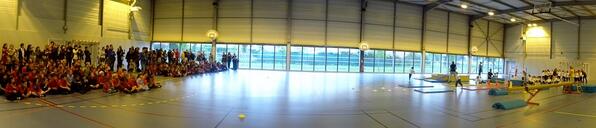
Foundation Stage impress Primary with their gymnastics and dance on Wednesday!


Wednesday, June 4, 2014

Measuring carefully

Sometimes even grown ups don't measure things properly and check their measurements. For instance recently when the SNCF wanted new trains, they didn't measure the platforms carefully:


So, we're going to try and make sure we measure carefully and check our measurements!

We're measuring various bones in our body, particularly the humerus and the femur, measuring twice to be make sure!


Next day...

To get better quality data, we've got eight different people to measure our humerus today.

Here's a chart of our humerus length and height:

Do you think there's a link between the two? Would it make sense to draw a line through the points or are they too scattered? Where would you put the line?

Biggest dinosaur - the measurements

This week we looked again at that news item about the biggest dinosaur being discovered. In the news report it said that the dinoasaur weighed the same as 14 elephants.


Someone asked the question: how we could know the weight of the dinosaur from a bone measurement?

Suppose we had some weights and femur lengths from animals alive now, we could draw a line on a graph and see where the unknown ones could be. We tried it. We drew a sketch graph, added lines and some of our estimates:


But, as Rozenn pointed out, we needed a bigger graph if this new dinosaur really weighed the same as 14 elephants!


To check the measurements we looked at some data for femur length and dinosaur weight. Together we entered it into a spreadsheet and plotted a graph:

We drew a really good line right through the points:


Like this:
But, as Rozenn said, to include this new biggest dinosaur, we're going to have to make the graph bigger:

Where would the line go now?

And, given that the femur in the picture looks around 2.6 metres (or 2600 millimetres) long, using the graph, how heavy would you say the new dinosaur is?

Monday, June 2, 2014

Anansi


We're enjoying lots of Anansi stories at the moment. Anansi is a story character from the Ashanti people of Ghana. He's a spider, but a very anthropomorphic kind of spider.

Here are some of his stories:


Sunday, June 1, 2014

Cricket Introduction

While we all are waiting for the world cup. I will tell you about cricket.
Cricket is a outdoor game in which we use a bat and  ball .
Each team has 11 players.
Cricket was originated in England  about 1550.

Here is a picture

Pollock to Hussey.jpg

There are 3 types of cricket overs,

1.  20 overs
2.  50 overs
3.   test

An over has six balls to be bowled.
There will be a batting team and a bowling team.The batting team has to score as many runs as possible , while the bowling team has to stop them from taking lots of runs and take wickets (there are 10 wickets ).
A test match has unlimited overs, but if the team  runs out of wickets , their innings is over.

The league   Indian premier league  ( IPL) today is the finals kkr vs kxip ( kings xi Punjab vs Kolkata  knight riders 0  today = 1 June 2014


The cricket world cup is in 2015.The current champions is India, but the most successful is Australia.

Next: cricket info cricket rankings and the winner of IPL finals.

The Museum

On Friday we went to the museum. It had a lot of stuffed animals. In the entrance there was a ginormous elephant and a pterodactyl.The first room was full of crystals. This is my haiku:
snowy glowing white
spiky white diamond beauty
I love it so much 

   The next room was about the continent.There was a film. All  the continents were moving in fast motion and in 6 billion years time the world will explode!  Another class was already in the room but we watched it anyway. As we were walking to the next room, we spotted some skeletons. I sketched a skeleton that looked like a dinosaur, but it was a hedgehog.
Up in the sky was a whale. It was ginormous. After that we saw more stuffed animals. After lunch we went home. I had a really good time.